My flight to Detroit via Washington D.C. was canceled, ironically because of bad weather in my southern transfer. Now I’m in La Guardia waiting for a flight to Charlotte, NC, fairly exhausted from a couple nights of inadequate sleep, late-night adventures and city life.
I left QEJ on Friday. Reina and Jay and Michelle made a big deal about my last day, which was nice of them, considering that QEJ gets a lot of interns and I was only with them for three weeks. I stayed up till two the night before baking brownies and cookies in Chloe’s kitchen, which proved difficult because of the lack of grocery ingredients available at midnight in NYC, namely cocoa powder. Desperate at 12:30 a.m. and at my fifth store, which was closing, I grabbed a microwaveable snack-sized brownie tray and decided that was the closest cocoa substitute I’d find. Thankfully, if you add eggs, flour, sugar, chocolate chips and butter to most anything, it becomes delicious.
The workday wasn’t productive at all – due to late night cooking, I got in around 11:00 a.m., chatted with staffers and made casual revisions to the report. Around noon the cute intern came in, and that was more distracting, and then Reina and I went to get coffee.
At 1:00 some others joined us and we had a meeting for the shelter safety campaign. The campaign targets two shelters and focuses on documenting and diminishing the rampant violence the city claims is non-existent. We laid out charts against a wall, and read from them to update each other on the various steps along the way. In the hallway, lined up, I looked at each person there and found myself in awe. I feel so lucky to know them all, the volunteers and staffers who have devoted themselves to this often-ignored effort, and how despite the often-depressing subject matter, are hilarious together and hopeful about our impact as individuals.
After that, we headed over to the CUNY graduate center to attend the research release presentation of a group called the Young Women’s Empowerment Project from Chicago. Their work has a lot overlap with QEJ’s, because they focus on documenting the resistance and resilience of women in the sex trade to institutional and individual oppression. One of my favorite points they made (because of its truth, not because I like it) is that violence against women in the sex trade is often viewed as individual oppression, when in fact it is individual oppression enhanced and encouraged by institutional oppression. Example: a man beats a woman in the sex trade. That’s individual oppression, if you ignore the fact that the man has probably been conditioned to value that woman less because of her gender and economic position. But then the police she is afraid to report the crime to, and the hospitals that refuse to treat her without insurance, perpetuate that oppression. These things don’t shock me as much as they used to shock me. The pattern is easily recognizable. What confuses me now is how I was able to live in complete ignorance of these situations, and of larger-scale oppression, for so long. After the presentation, Michelle and Reina took us all out to dinner and asked me what I’d gotten from my time with them. It was the easiest question ever to answer. In these three weeks, I’ve learned about different worlds and remembered that every person has a story worth telling and worth paying attention to. I’ve grown up a lot, and because that phrase is vague and possibly irrelevant, I’ll explain that “growing up” in this case is a feeling, and awareness about my surroundings and responsibilities, and a confidence, that I didn’t have before. And from these three weeks I’ve shaped the rest of my life’s work. I might not necessarily be in a community organizing office in NYC, although that’s a possibility. But I will be doing my individual part to end oppression, wherever I am.
When we stepped out of the restaurant, it was freezing out. We said goodbye, and Michelle said she would email me the report in the next couple of days to edit. They walked back to QEJ, and I walked in the opposite way to the subway station, always portable, with pajamas in the second pocket of my backpack.
Two friends, one of whom goes to NYU and the other who goes to Oberlin, were waiting at Union Square. The three of us have notoriously good adventures. It was Abby’s first night in the city and my last. We toasted over Cuban food, went to a friend’s party and ended the night at the same falafel shop on St. Marks that Chloe had taken me to on our first day. It was the perfect way to end my incredible stay, and writing about it makes me less grumpy to be in an airport indefinitely.
Finally, to anyone reading from QEJ, one of my host houses, or from my family, thank you. An education is one of the most valuable things anyone can ask for, and you’ve given me that. I wish you all love and the best of luck.
Saturday, January 30, 2010

Thursday, January 28, 2010
real-life application attempts
Last night, Chloe and I left her apartment at 10:00 p.m. because it was our last night together in NYC (of course, we'll be living together in a week anyhow) and it was adventure time. I had meant to explore some of the areas the people in the report talk about, like the areas where police harassment occurs, and it was my last unscheduled night. What followed:
- Joined up and had bubble tea with an NYU friend to prepare us all for the evening
- Said goodnight to said NYU friend and walked the full length of Christopher St. in the West Village. It's often mentioned in the report, and I wanted to see it for myself. It was cold and late on a Wednesday night, and I had a feeling the walk would be anticlimactic. In parts, Christopher street was bustling, and there were gay bars and rainbow flags, and Chloe laughed at me for enthusiastically saying, "my people!" as we passed by. In other parts, the street was desolate except for a couple people at a time, and it did seem kind of sketch but it was hard to tell if that was just a projection of our expectations. Which was when I realized - I could never experience Christopher street like the people on the survey did. Because of my background, and my naiveté, and the time of night, I could walk down the same street and see it completely differently than someone who took the Welfare Warrior's Research Collaborative survey. At the same time, or maybe because of this, our Christopher street walk felt somewhat like a museum tour - the mood felt reverent and we were trying to understand it like you might try to understand what it was like for a sculptor creating her art back in the 19th century.
-Walked all the way from the West Village to the East Village, and decided it was time to get a bathroom. In some 24-hour sketch pizzeria, a man came up to me while Chloe was otherwise occupied. I don't know why these things always happen to me. He started gesturing wildly, and I couldn't understand what he was trying to communicate. He kept pointing at his ear, so I gathered he was deaf, and then he ran to the counter and brought back a napkin. "CAREFUL" he wrote on the top, "NIGHT LATE." He turned it around, and then wrote "WORLD DANGER." It was disconcerting. A couple of people came over to make sure everything was under control, and I assured the man as best I could with hand motions that it was going to be fine, but Chloe and I left as soon as we could and took the subway back to her place.
Unrelated - I came across a quote in a report I read for some background knowledge, which I really liked: “If you have come to help me you are wasting your time. But if you recognize that your liberation and mine are bound up together, then let us walk together.” -Lila Watson. I like it because it's so important to remember that oppression, even though it visibly hurts minority populations, hurts and stifles us all, and that we should all be working toward its end.
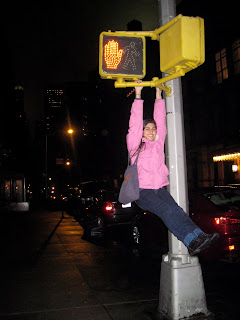
Ok, enough theorizing - here are pictures from last night.


- Joined up and had bubble tea with an NYU friend to prepare us all for the evening
- Said goodnight to said NYU friend and walked the full length of Christopher St. in the West Village. It's often mentioned in the report, and I wanted to see it for myself. It was cold and late on a Wednesday night, and I had a feeling the walk would be anticlimactic. In parts, Christopher street was bustling, and there were gay bars and rainbow flags, and Chloe laughed at me for enthusiastically saying, "my people!" as we passed by. In other parts, the street was desolate except for a couple people at a time, and it did seem kind of sketch but it was hard to tell if that was just a projection of our expectations. Which was when I realized - I could never experience Christopher street like the people on the survey did. Because of my background, and my naiveté, and the time of night, I could walk down the same street and see it completely differently than someone who took the Welfare Warrior's Research Collaborative survey. At the same time, or maybe because of this, our Christopher street walk felt somewhat like a museum tour - the mood felt reverent and we were trying to understand it like you might try to understand what it was like for a sculptor creating her art back in the 19th century.
-Walked all the way from the West Village to the East Village, and decided it was time to get a bathroom. In some 24-hour sketch pizzeria, a man came up to me while Chloe was otherwise occupied. I don't know why these things always happen to me. He started gesturing wildly, and I couldn't understand what he was trying to communicate. He kept pointing at his ear, so I gathered he was deaf, and then he ran to the counter and brought back a napkin. "CAREFUL" he wrote on the top, "NIGHT LATE." He turned it around, and then wrote "WORLD DANGER." It was disconcerting. A couple of people came over to make sure everything was under control, and I assured the man as best I could with hand motions that it was going to be fine, but Chloe and I left as soon as we could and took the subway back to her place.
Unrelated - I came across a quote in a report I read for some background knowledge, which I really liked: “If you have come to help me you are wasting your time. But if you recognize that your liberation and mine are bound up together, then let us walk together.” -Lila Watson. I like it because it's so important to remember that oppression, even though it visibly hurts minority populations, hurts and stifles us all, and that we should all be working toward its end.
Ok, enough theorizing - here are pictures from last night.


Wednesday, January 27, 2010
Denial and productivity can go hand in hand

All of the work from my three weeks is starting to come together. One of my supervisors, Michelle, has me writing sections of the report, which is going to be finished on Tuesday. I started with the section on income, and how the people in the survey and in the Welfare Warriors support themselves. My first reaction to the assignment was panic - how on earth could I write such a crucial piece? But then, I realized that I had done the coding for the income data, and transcribed about twenty hours of people talking about income, and looked up federal poverty guidelines, and read through reports on LGBT income as compared to non-LGBT people. I actually knew a good deal about how low-income LGBTGNC people supported themselves, and definitely enough to write five or so paragraphs. Rejuvenated by that knowledge, and a coffee break with some staffers, I worked until the executive director awkwardly insinuated that I should get out so he could lock up and go to his board meeting.
I'm ignoring the fact that this trip is over in four days, and I still have to do all of those things you're supposed to do when you go to New York City, like buy your family presents, and see a Broadway show (which I get to do tomorrow!), and walk through Times Square. On the upside, though, my body is tired from switching living spaces every week/weekend, and I'm excited to relax in Ann Arbor for a couple of days. And then, Oberlin, which seems so familiar and unfamiliar and promising and scary all at the same time. I talked with a friend for awhile a couple days ago about starting up/continuing existing activism on campus surrounding trans issues, and prison issues. It's comforting to know that even though I won't wake up and work from 10-6 on the front lines of the community organizing world, I can still be involved. I'll be home Saturday, but QEJ is going to let me copyedit and revise the report on Sunday. It's not like I'm really leaving then, right?
Monday, January 25, 2010
The gist is that prisons suck, the long version will follow
Just had another one of those days so long that I forget it had a beginning.
It did, though. For the first time during my stay, it was raining and I spent a long time fumbling in the dark for clothes before I finally got out at a quarter till eleven. New York feels pessimistic when it's rainy, and the wind blew my umbrella out, but the QEJ office was warm as always.
I spent the first hour coding data to the question, "How do you keep yourself and others safe?" and got to have a check-in with my boss Reina. She's an exceptional listener, I'm trying to take pointers. She makes you feel like what you've got to say is of the utmost importance, and takes notes on it in her book even if we're just talking about our weekends. Today, she updated me on a bunch more meetings I'll be going to this week, and gave me a stack full of literature to prep me for them. Besides the education I'm getting from working on the research, I've had an extensive schooling on all of the issues QEJ works with from Reina, Michelle and the people in the office. And today's pile was not the easiest material to get through.
First, there were essays on how reproductive rights are an LGBTQ issue. I'd never thought about this, and just assumed that because those rights concern the liberal ideology, LGBTQ people probably cared about them. I'm going to post an essay here tomorrow, but for now I'll explain what I internalized: it's not so much that LGBTQ people should have the right to terminate pregnancies, as per the reproductive rights headlines in the mainstream media, but that LGBTQ people should have a right to HAVE children. This includes being able to adopt where we want, but adoption and fertilization techniques are expensive. It's simpler than that - LGBTQ people have the right to not be sterilized.
This is where my readings on the Prison Industrial Complex, or the PIC, come in. Prisons in the U.S. also function as population control, because the people inside them are disproportionately people who are low-income, of color, LGBTQ or disabled. Inside prisons, people can't have children. And when they come out, they don't have the same rights, and so they often end up back in prison. But back to sterilization - a trans person who goes into the prison system isn't going to be put in the men or women's space based on what gender he/she/zie identifies OR the marking on the birth certificate - the person is going to be put where their genitalia matches. Pay no mind that a trans woman in a male shelter is much more likely to be sexually assaulted - the prison system's main goal is that nobody gets pregnant. If that's not enough, the social security system also tries to sterilize trans people. In order for people to change the gender on their cards, they need to have a specific kind of sexual reassignment surgery - bottom surgery - that sterilizes them. There are many types of gender reassignment practices that people can take, and much less invasive ones, like hormones, where they can have biological children down the line.
It gets worse. Most of the time, the PIC doesn't let trans people who are on hormone therapy continue it when they're in prison. This completely messes up the body, and causes confusion and humiliation. Prisoners can beg the guards to let them in the correct gender facilities, but guards only let them change with gender reassignment surgery of the genitals, but don't offer them access to those services. It gets brutal, people. There are cases - and by no means isolated cases - of trans people in prison taking matters into their own hands. Yes, they perform their own genital reassignment surgery in prison. Which is, needless to say, dangerous and sometimes fatal.
I also learned about hate crimes legislation. Sounds nice, right? Except that the legislation puts even more people into the criminal justice system, without dealing with their homophobia, transphobia or psychological issues. It's a straightforward idea, but listen to this - the legislation sends them to prison. Who's disproportionately waiting for them in prison? LGBTQ people, and all of the other oppressed minorities. If they're a trans person in the wrong gender section of the shelter, they may even be in the same cell.
And just as a side note, these prison systems - they're not just there to house "criminals." Whole systems of economy are based on them, and they are often built for the sole purpose of providing jobs to the builders who build them, the guards who guard them, the people who feed the prisoners, etc. Out there in this free nation of ours, there are even prisons that the government charters for private businesses to build. Guess how much accountability there is in those prisons?
These are just a couple of examples, and I read about so much more. I want to share all of it. In the end, we have to imagine a world where there is a completely different prison complex, and there are different systems of power, and that almost sounds science-fiction-y in the context of our reality. But it's what the people oppressed by this system do, every day. Reina reminded me that we don't have to be hopeless. We all just have to be conscious, and ready for change.
After my reading, I got to take a trip to Bluestockings, a famous activist, anarchist and queer bookstore/cafe. A group in QEJ called Connecting Communities is looking into making a zine, which is an artsy magazine, with some of the survey data combined with an emotional, personal twist. I poured over the zines, eagerly identifying different design elements that would work for them - interactive features, shorts, poetry - and it made me miss my journalism days so much. I don't want them to be over. So they won't be. Good, glad that's decided.
Again traveling into a different class world, I went to the upper west side to meet cousins I've never seen before for dinner. They were lovely, and musical, and big shots. The father owns a recording company, famous for the Kidz Bop compilations (yeah, they're still happening) and apparently, although I didn't know this, representing some of my favorite singer-songwriters. He asked me if I knew Dar Williams, and I said that of course I did. I was listening to "Iowa" on the subway to his house. "Yeah," he said, "Dar and I were just talking about 'Iowa' on the phone earlier today - she decided she's not going to re-record it for her new album." No big deal.
I had a pleasant cab ride home (I splurged because it's on the opposite end of town) with a man from Guinea. Cab conversations are my favorite. This man talked to me about systems of power in his home country - some things are sadly predictable - and how he wants to go back to school. "Good luck with all you do," he told me as I got out, and I said back, "Go to Guinea and change things!" before grabbing my umbrella. He laughed and said he'd do his best. And that's really all that we can do, all of us individuals making tiny rebellions against systems of oppression that have wound their way around billions of people for as long as we can remember.
It did, though. For the first time during my stay, it was raining and I spent a long time fumbling in the dark for clothes before I finally got out at a quarter till eleven. New York feels pessimistic when it's rainy, and the wind blew my umbrella out, but the QEJ office was warm as always.
I spent the first hour coding data to the question, "How do you keep yourself and others safe?" and got to have a check-in with my boss Reina. She's an exceptional listener, I'm trying to take pointers. She makes you feel like what you've got to say is of the utmost importance, and takes notes on it in her book even if we're just talking about our weekends. Today, she updated me on a bunch more meetings I'll be going to this week, and gave me a stack full of literature to prep me for them. Besides the education I'm getting from working on the research, I've had an extensive schooling on all of the issues QEJ works with from Reina, Michelle and the people in the office. And today's pile was not the easiest material to get through.
First, there were essays on how reproductive rights are an LGBTQ issue. I'd never thought about this, and just assumed that because those rights concern the liberal ideology, LGBTQ people probably cared about them. I'm going to post an essay here tomorrow, but for now I'll explain what I internalized: it's not so much that LGBTQ people should have the right to terminate pregnancies, as per the reproductive rights headlines in the mainstream media, but that LGBTQ people should have a right to HAVE children. This includes being able to adopt where we want, but adoption and fertilization techniques are expensive. It's simpler than that - LGBTQ people have the right to not be sterilized.
This is where my readings on the Prison Industrial Complex, or the PIC, come in. Prisons in the U.S. also function as population control, because the people inside them are disproportionately people who are low-income, of color, LGBTQ or disabled. Inside prisons, people can't have children. And when they come out, they don't have the same rights, and so they often end up back in prison. But back to sterilization - a trans person who goes into the prison system isn't going to be put in the men or women's space based on what gender he/she/zie identifies OR the marking on the birth certificate - the person is going to be put where their genitalia matches. Pay no mind that a trans woman in a male shelter is much more likely to be sexually assaulted - the prison system's main goal is that nobody gets pregnant. If that's not enough, the social security system also tries to sterilize trans people. In order for people to change the gender on their cards, they need to have a specific kind of sexual reassignment surgery - bottom surgery - that sterilizes them. There are many types of gender reassignment practices that people can take, and much less invasive ones, like hormones, where they can have biological children down the line.
It gets worse. Most of the time, the PIC doesn't let trans people who are on hormone therapy continue it when they're in prison. This completely messes up the body, and causes confusion and humiliation. Prisoners can beg the guards to let them in the correct gender facilities, but guards only let them change with gender reassignment surgery of the genitals, but don't offer them access to those services. It gets brutal, people. There are cases - and by no means isolated cases - of trans people in prison taking matters into their own hands. Yes, they perform their own genital reassignment surgery in prison. Which is, needless to say, dangerous and sometimes fatal.
I also learned about hate crimes legislation. Sounds nice, right? Except that the legislation puts even more people into the criminal justice system, without dealing with their homophobia, transphobia or psychological issues. It's a straightforward idea, but listen to this - the legislation sends them to prison. Who's disproportionately waiting for them in prison? LGBTQ people, and all of the other oppressed minorities. If they're a trans person in the wrong gender section of the shelter, they may even be in the same cell.
And just as a side note, these prison systems - they're not just there to house "criminals." Whole systems of economy are based on them, and they are often built for the sole purpose of providing jobs to the builders who build them, the guards who guard them, the people who feed the prisoners, etc. Out there in this free nation of ours, there are even prisons that the government charters for private businesses to build. Guess how much accountability there is in those prisons?
These are just a couple of examples, and I read about so much more. I want to share all of it. In the end, we have to imagine a world where there is a completely different prison complex, and there are different systems of power, and that almost sounds science-fiction-y in the context of our reality. But it's what the people oppressed by this system do, every day. Reina reminded me that we don't have to be hopeless. We all just have to be conscious, and ready for change.
After my reading, I got to take a trip to Bluestockings, a famous activist, anarchist and queer bookstore/cafe. A group in QEJ called Connecting Communities is looking into making a zine, which is an artsy magazine, with some of the survey data combined with an emotional, personal twist. I poured over the zines, eagerly identifying different design elements that would work for them - interactive features, shorts, poetry - and it made me miss my journalism days so much. I don't want them to be over. So they won't be. Good, glad that's decided.
Again traveling into a different class world, I went to the upper west side to meet cousins I've never seen before for dinner. They were lovely, and musical, and big shots. The father owns a recording company, famous for the Kidz Bop compilations (yeah, they're still happening) and apparently, although I didn't know this, representing some of my favorite singer-songwriters. He asked me if I knew Dar Williams, and I said that of course I did. I was listening to "Iowa" on the subway to his house. "Yeah," he said, "Dar and I were just talking about 'Iowa' on the phone earlier today - she decided she's not going to re-record it for her new album." No big deal.
I had a pleasant cab ride home (I splurged because it's on the opposite end of town) with a man from Guinea. Cab conversations are my favorite. This man talked to me about systems of power in his home country - some things are sadly predictable - and how he wants to go back to school. "Good luck with all you do," he told me as I got out, and I said back, "Go to Guinea and change things!" before grabbing my umbrella. He laughed and said he'd do his best. And that's really all that we can do, all of us individuals making tiny rebellions against systems of oppression that have wound their way around billions of people for as long as we can remember.

Sunday, January 24, 2010
There are some things we don't talk about

A quick entry before Chloe gets back with our friend Carter and festivities ensue:
FOMO (fear of missing out) again rules my life. I want to see everyone, and do everything, and it's hit me that I'm only here for five more days.
Luckily, I'm well-rested. This weekend I stayed with my friend Sophia in the Hamptons. It felt weird to be in a place notoriously known for being high-income after having spent the week working with issues surrounding people with low-to-no-income. In this society, we're not supposed to talk about class or racial stratification, but I couldn't help but notice at a restaurant we went to on Saturday that the people cooking appeared to be hispanic, the waitresses appeared to be white, and the owner appeared to be a white male (I say appeared, because of course, I could be wrong about how they identify). The customers - all white, too.
I don't know what to make of this still, except to say that I'm trying to remember that we generally don't choose what class we are or however else we identify, and that people are people. I had a wonderful time hanging out with Sophia and her family - you always get to know a person so much better that way. We got about as much nature as possible crammed into the two days, hiking and running in the woods and walking on the beach. On Sunday, it was rainy, so we had a chill movie and Kraft macaroni-and-cheese afternoon. Somedays, Annie's just doesn't cut it, comfort-food-wise.
Tomorrow begins the home stretch for my stay here, and for the Welfare Warrior's research report. I'm excited because Michelle has told me that I will get to write some of it, which is scary and great. Like everything else, I hope there's enough time to dedicate my all to it.

Friday, January 22, 2010
Creating Change
I have special permission to post about a person named Dwayne. I've heard him while transcribing for about two weeks, and met him a couple times, so I feel like I know him a little. Jay, another QEJ staffer, told me more about him. In short, Dwayne was in the men's shelter and began going to the QEJ support groups about four years ago. Since then, he became a shelter facilitator, joined Q-Crew (a video blog production group) and the Welfare Warriors Research Collaborative (that's how I know him). He's now out of the shelter system and in his own place, on social security. According to Jay, and from what I've seen, he's a great guy, and volunteers for anything going on around QEJ.
QEJ is trying to get enough money to send Dwayne to Creating Change, the nation-wide annual conference held by the Lesbian and Gay Taskforce, this year in Dallas, Texas. I mentioned earlier that QEJ plans to release the Welfare Warrior's research report there, and Dwayne's been a crucial member in the group. He plans to lead the workshop there.
I feel a little uncomfortable asking people to donate something, (most of us are poor college students, anyway) but this cause is totally manageable. So far, QEJ has $265.00 in pledges, and they need $400 for roundtrip airfare and four days of meals. So basically, I'm asking anyway. If you think you can help (I'm donating $15, and it can even be $5 or something like that) send me an email. It's ahalpert @ oberlin.edu (the spaces are to stop spammers).

(Dwayne is on the left, Jay is on the right.)
QEJ is trying to get enough money to send Dwayne to Creating Change, the nation-wide annual conference held by the Lesbian and Gay Taskforce, this year in Dallas, Texas. I mentioned earlier that QEJ plans to release the Welfare Warrior's research report there, and Dwayne's been a crucial member in the group. He plans to lead the workshop there.
I feel a little uncomfortable asking people to donate something, (most of us are poor college students, anyway) but this cause is totally manageable. So far, QEJ has $265.00 in pledges, and they need $400 for roundtrip airfare and four days of meals. So basically, I'm asking anyway. If you think you can help (I'm donating $15, and it can even be $5 or something like that) send me an email. It's ahalpert @ oberlin.edu (the spaces are to stop spammers).

(Dwayne is on the left, Jay is on the right.)
The day that didn't end

I think I fell asleep before I finished that last post. Something about the combination of no rest, life re-evaluation and thought-provoking conversation and a nine-hour long day made something click gears into place. Among the things I talked about yesterday, I also:
- Attended a phone meeting between Reina and a bunch of other welfare organizers, who are setting up a press conference. After five years, they finally passed an LGBTQ welfare sensitivity training law, which is going to hopefully revolutionize the system. It was at the end of the day, so my attention was scattered, but they talked about speakers and politics, and it was cool to listen in on real-world, high-stakes organizing
- Placed a call to the "GLBT Community Liaison" for the police force at the encouragement of the office. I had been transcribing and heard another awful story about police neglect, which made me ask myself -- Are there good cops? Are there queer cops? Both of these things, to me, made sense, but I asked the office. There were about six of us in at that point, and everyone else started laughing. "What," I said, "there aren't people who join the police force to do good, or make systemic change from the inside?" They spoke carefully, and said that there might be some people who start off with good intentions. But they explained that the police system isn't designed to help people, it's designed to enforce systems of power. The people who join the police force are given exorbitant amounts of power, and in the end they are instructed to carry out the tasks they're assigned, which usually don't help anyone. It corrupts people. The prison system, instead, acts as an expensive shelter system, half of whom should be in treatment programs, not jail. But anyway, apparently this liaison guy loves talking to QEJ, and they said I could call and ask for myself. I did, so I might talk to him today.
- Went over to the CUNY and got more data to code, the open-ended answers to the question: what is your income? I'm not supposed to write the figures here, but they are lower than I ever thought they could be. "This is why we're doing this work," Michelle told me as I stared at them in disbelief.
- Finally got to watch the documentary that the Welfare Warriors made about themselves. It's so beautiful, cutting between protestors on the street and feature interviews with the participants. I got to place a lot of voices to faces I'd heard over the tapes.

- Asked Reina and Michelle for book and film recommendations. I think this was a good call. So far Michelle has told me to read Lisa Duggan's "Twilight of Equality" which addresses race, sexuality, and the limits of the idea of equality. I want more.
I'm sitting in a coffee shop near Union Square and I should get to work. This weekend should be peaceful, I'm going to Long Island with Sophia. I like this whole work-till-you-drop thing during the week, and then do-absolutely-nothing thing on the weekend.
If you want to check it out, QEJ was featured in a PBS documentary. This clip is about 10 minutes long.
Subscribe to:
Posts (Atom)
